
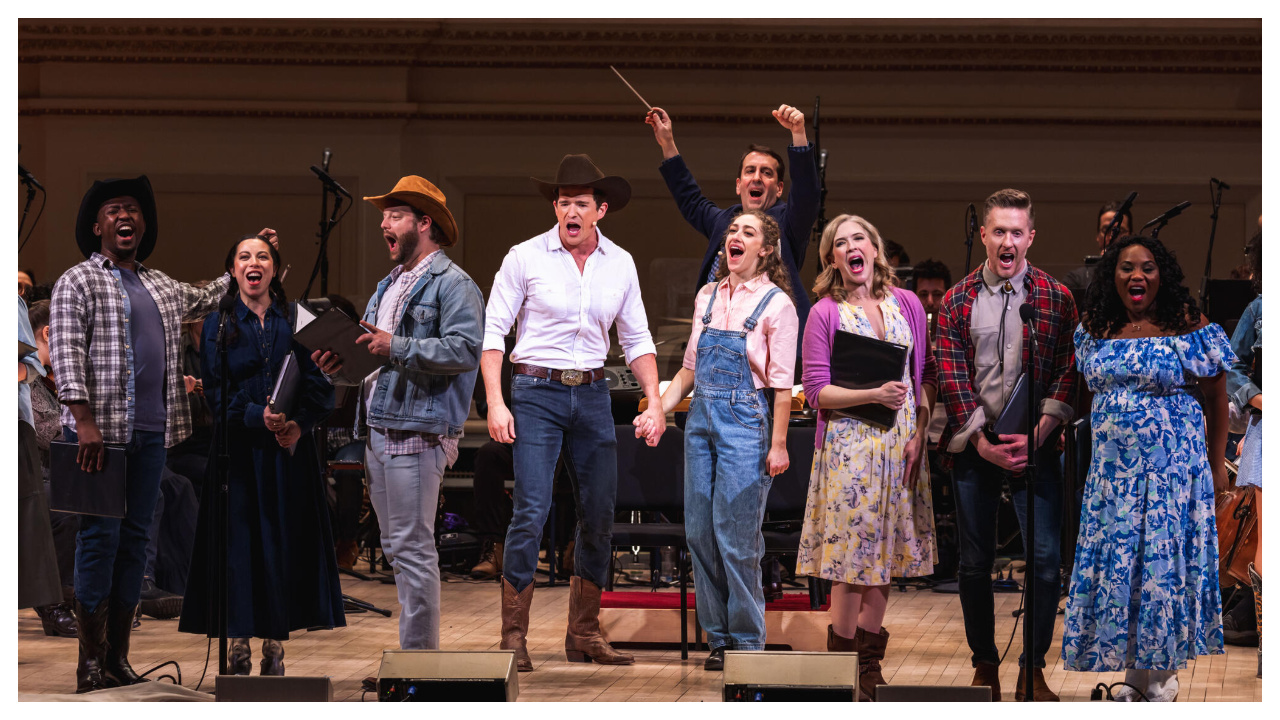
On January 12, 2026, Carnegie Hall and Orchestra of St. Luke’s presented Rodgers and Hammerstein’s cherished musical ‘Oklahoma!’ Featuring the original Broadway orchestrations by Robert Russell Bennett, and a well-rounded cast of artists, the performance was an undoubtedly exuberant celebration which succeeded in thrilling the audience, and made an excellent launch for Carnegie Hall’s ongoing ‘United in Sound’ festival.
Leading the Orchestra of St. Luke’s was company music director and conductor Rob Berman. Attentive to the smallest aural details, Berman beautifully illumined Rodgers’ score to splendid effect. Berman also had moments where he joined the antics, such as his lines during the basket auction, and being assaulted and robbed of his baton when Aunt Eller loses her temper during the brawl of ‘The Farmer and the Cowhand’ number.
In the role of Curly McLain, Emmett O’Hanlon made his Carnegie Hall debut in highly-charming fashion. His opening number ‘Oh, What a Beautiful Morning,’ introduced a firm yet warm baritone which carried into much of ‘Surrey with the Fringe on Top’ until the more sensitive moment with Laurey saw him gentle his tone to beautiful effect as he closed this latter number with an almost classical vocal approach. These aspects served O’Hanlon well and, coupled with a congenial, laid-back demeanor, gave his interpretation of Curly a nuanced portrayal, especially during the moments of tension like his showdowns with Jud.
Opposite Hanlon was Micaela Diamond in the role of Laurey Williams. Her sarcastic reprise on Curly’s song served as an endearing introduction to her character, and her moments of sincerity saw Diamond truly shine vocally. Their duet, ‘People Will Say We’re in Love,’ showcased these qualities wonderfully as they traded rebuffs while their truer feelings began to show through the cracks. Their later reprise upon their engagement was utterly passionate, and saw Diamond and Hanlon in excellent vocal balance as they delivered the climactic notes standing atop the chairs of the set. I was most taken with Diamond’s expert use of phrasing and colors through the accent of her character, enhancing rather than limiting her expressivity and leading to no shortage of captivating moments through her numbers.
One of the evening’s highlights was without question Jasmine Amy Rogers as Ado Annie. Providing just the right amount of comedic absurdity, her take on ‘I Can’t Say No’ was energetic and infectious as she let loose her many feelings with a breadth of expressive vibrato which spoke much of her romantic conundrum. Much of her unsung moments were sources of humor as well; with Cheena’s Ali Hakim, Annie’s sense of naivety often set the peddler up for some well-delivered lines, while her moments with Durand saw her as the one setting the pace. Their comedic sensibility made their rendition of ‘All or Nothing’ as sweet as it was silly, and gave the ‘Betty Boop’ star the chance to show some quick, sultry moves as she teased Durand during the instrumental sections.
As Will Parker, Andrew Durand was both affable and engaging as his arc saw him constantly negotiate with Annie, her father, and Ali Hakim, playing well off these differing kinds of wise-crackers. His vivacious intro number ‘Kansas City’ saw his lines delivered with a suitably rustic phrasing that belied the support and technique needed as he interacted and danced among the members of the chorus. Together, Durand and Rogers made a excellent pairing which let the side-plot of the musical get the audience as invested as they were in Curly and Laurey’s romance; while some castings take the comedy and accents of the side characters too far and lose something authentic in the process, this interpretation of the quarrelsome lovebirds was expertly done.
The main cast included Jonathan Christopher as Jud Fry. His interpretation of the hired hand saw him maintain a simpler façade for his initial interactions with Aunt Eller and Laurey, and reveal a more sinister character during his scene with Curly in the smokehouse. Their duet just moments before, ‘Poor Jud is Dead,’ saw the men display some soft yet rugged harmonies once Curly lured him more into the idea of hanging himself. His ensuing solo number ‘Lonely Room’ carried with a haunted sense of frustration as Christopher outlined the vast contrast of Jud’s stark reality and his idyllic vision of Laurey, while the tempo built to one last, anguished fermata to sell the deal and send him running offstage. His confrontation with Laurey later in the second half was highly gripping as the memories and senses that Jud is caught within lent a distant, obsessive quality to his lines, until her rebuke caused him to finally start boiling with anger, leading to a much more present threat. While I believe some modern interpretations tone down the predatory aspects of Jud’s character, Christopher’s portrayal held a nice sense of humanity as well as menace; one could almost feel bad for him until his truer colors rose to the surface, resulting in a mostly compelling antagonist for this evening’s drama.

Apart from the main cast, there were plenty of enjoyable moments from actors like Ana Gasteyer as Aunt Eller, who lent much humor to her moments onstage, as well as David Hyde Pierce as Andrew Carnes. This cameo role was a nice touch as Pierce lent a softer, more witty take to the trigger-happy farmer, treating Will more like a foolish son than a nuisance.
This concert staging had much to enjoy apart from the songs, with the chorus and singers often breaking into lighter dance segments to make the most of the Stern/Perelman stage, moving amidst and interacting with the orchestra they shared the floor with. While Agnes De Mille’s choreography lent much excitement when it appeared, I could not help but miss the ballets which feature in Laurey’s entire dream sequence, which was only performed instrumentally and came as a sort of entr’acte for the audience to enjoy.
While the cast and chorus gave their performances with great enthusiasm and sincerity, I was less crazy about the use of binders for much of their lines, as it often broke the immersion created to see them glancing back and forth between the binder and the character they’re addressing. Given how the main cast seemed perfectly comfortable putting the binders away for their actual songs, they felt more like a crutch than a support, and my least favorite instance was the binder-waving dance of the women’s chorus during the instrumental section of ‘Many a New Day,’ though the chorus themselves delivered some lovely, reassuring harmonies to Laurey for their part.
While much of the actual performance went off without a hitch, there were small technical gaffes as a result of the microphones like a small, persistent whine coming from a speaker somewhere in the upper reaches during much of the first half, and the occasional hum from a feedback loop during particularly dense moments from the ensemble. Though there are moments which can benefit from amplification, most of the cast did not sound like they needed it.
Nonetheless, Monday’s concert was an exceptional presentation of this beloved musical thanks to the passion of the artists and orchestra. Moments of comedy, earnest sentiment, and song were explored in rich detail, while the constant energy kept the show from feeling overly-long across its nearly three-hour runtime. While the recent Broadway production suffered from its deconstructionist take on the work, this concert presented an ‘Oklahoma!’ which honors its roots through its original orchestration, while the humanity of its cast served well to make it feel as relevant and meaningful as any modern-day tale.