
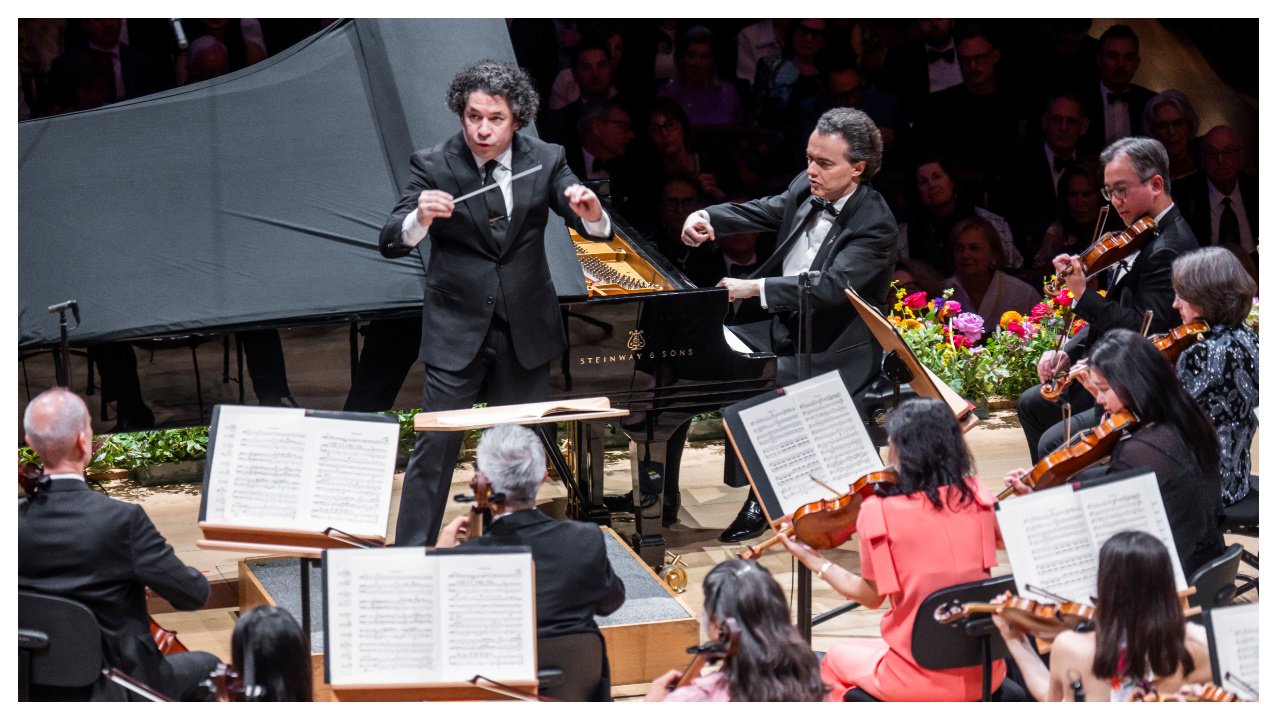
On April 28, 2026, the New York Philharmonic presented their Spring Gala, bringing together patrons of the arts together for a splendid evening of classical music. This season’s gala was held in celebration of philanthropist Barbara Tober and her late husband, Donald Tober. Conductor Gustavo Dudamel and orchestra were joined by renowned pianist Evgeny Kissin for an exciting program of Russian works.
The reception was a standard but lovely affair, featuring hanging gardens and floral arrangements by DeJuan Stroud and Robert Bloom, as guests mingled in their garden party formal attire.
Opening the program on a fitting note was ‘Prelude’ from Mussorgsky’s opera ‘Khovanshchina.’ A lower phrase from the winds beautifully leapt to a sustained height which, against the flutes and harps, quickly set a charged, romantic feeling through this initial piece. This sonorous ease unfolded beautifully towards the more expressive, lyrical themes of the selection, and found a nuanced contrast in the more ensuing funereal section of heavy chords and somber bell tolls.
Following this was the ‘Dance of the Persian Slaves’ from the same opera. The initial horn theme evoked a more sultry atmosphere bolstered by the lower string’s sustained measures before the texture was joined by the rest of the orchestra, elaborating towards wave-like soundings from the percussion, or more expressive passages which pivoted between a more relaxed opulence and a swift, almost-martial danger.
Next on the program was Scriabin’s ‘Piano Concerto in F-sharp minor, Op. 20,’ played by Kissin. This performance marked the first time in nearly ten years that Kissin has performed with the NY Phil, and made a splendid showcase of his talents; in particular I was taken by the articulacy of his trills, well-measured chords, and silky glissandos that balanced expressivity with superb technique in the ‘Allegro’ and translated into a sophisticated fervor in the ensuing ‘Andante.’ The closing ‘Allegro Moderato’ was delivered expertly and with a fluid power which shifted between gentle beauty and stormier textures as it navigated towards a strong, nearly-triumphant close.
This section was met with a standing ovation for Kissin and the orchestra, who responded in kind with two encores: Scriabin’s ‘Mazurka, Op. 25, No. 3,’ and Tchaikovsky’s ‘Nathalie-Valse, Op. 51, No. 4.’

Rounding out the concert with tremendous energy was the 1919 version of Stravinsky’s iconic ‘The Firebird Suite.’ The initial section ‘The Firebird and its Dance,’ rose from a smoldering depth laid by the cellos to prowl this dark yet interesting atmosphere, before a series of frantic swells lent more energy to this exploration of the space. The ensuing ‘Princesses’ Round Dance’ was a charming shift as the winds broke the silence, and were joined by the harps and strings for tender yet refined passages.
Lending an excellent heat was the ‘Infernal Dance of King Kashchei,’ which kicked in with hard drums and a fierce charge from the winds. The frenzied measures of running horns and strings were nicely accented by small touches like the sporadic flicker of the xylophone. This utter power was stunning in itself, and its sudden transition into the following ‘Lullaby’ left the silence filled with residual passion for the mystique of the relaxed, wind-led measures to play off.
The finale, opened by a warm horn motif, beautifully elaborated as it carried across the rest of the orchestra and into a gorgeous and rich outpouring of this stunning conclusion. A tour de force of Romanticism, this concert was replete with lyrical beauty and classical virtuosity. Taking this sentiment to iconic heights, a final encore came this evening in the form of the ‘Pas de Deux’ from Tchaikovsky’s timeless ballet ‘Swan Lake.’ This selection was an exultant celebration of romantic and musical beauty, and it was indeed a treat for me to hear this particular orchestra perform from the ballet repertoire.
Tuesday’s gala concert was a thrilling event thanks to the talents of Dudamel, Kissin, and the musicians of the philharmonic. While the program itself was straightforward in its scope of Russian Romanticism, it was illuminated by tremendous beauty and a enchanting, at times intoxicating, fervor. The event raised some $3 million in support of the New York Philharmonic, and has thus far proved the most successful Spring Gala for the company.