
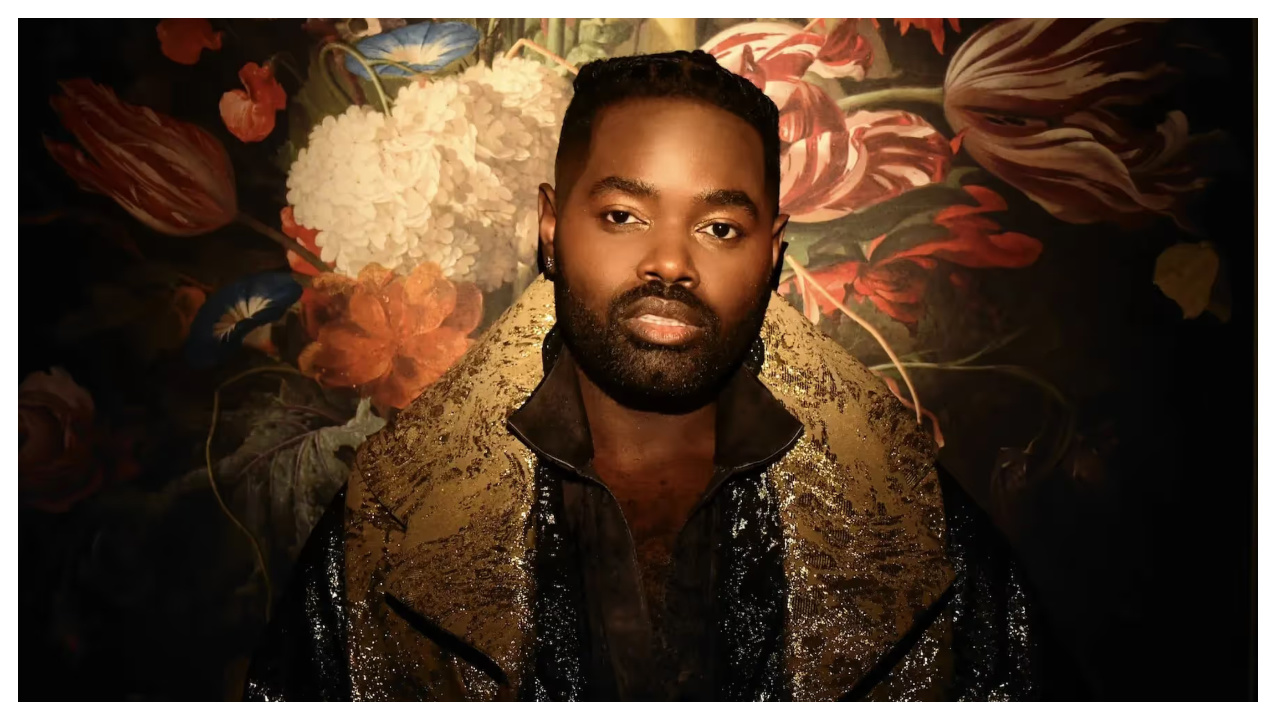
On July 17, 2026, PENTATONE released ‘Over My Head,’ featuring countertenor John Holiday in what is his debut solo album. I last had the chance to interview Holiday in 2018, and recent years have seen him delight audiences on some of the world’s leading opera stages such as the Metropolitan Opera, Bayerische Staatsoper, and more. In 2020, Holiday also appeared on NBC’s ‘The Voice,’ where his range and versatility often surprised the judges as much as the audience.
Available on most streaming platforms, ‘Over My Head’ draws from a number of genres which speak to Holiday’s experiences as an artist both on and off the stage, with selections such as Hall Johnson’s spiritual ‘I’m Gonter Tell God All O’ My Troubles;’ Bart Howard’s timeless standard ‘Fly Me to the Moon;’ and Abel Meeropol’s haunting ‘Strange Fruit,’ among others.
I had the opportunity to talk with Holiday, and gain some insight on the process behind the new recording, the feelings which brought it into being, and some of his upcoming engagements.
SF: Your album blends a number of styles, what would you say is the inspiration behind the concept?
JH: “When I thought about the album, I wasn’t necessarily thinking about a concept for the album. More than anything, I wanted to present my most authentic self to my audience and those who would come to know me through ‘Over My Head.’ In my everyday life, I show up as the fully realized version of myself that my audiences get on the stage. For me, that means it’s important to bring all of the aspects of my life to the fore, all the facets which have helped to develop the human being that I am now. And that means including my gospel roots, jazz, and the classical music that is so important to me today – being unashamedly John Holiday.”
SF: This being your first album as a solo artist, how has this compared to past experiences in the recording studio?
JH: “Because this is my own project, there was a sense of both calm and urgency: calm, because it is my own project and I got to develop it, on my own terms. In this project, I have had the opportunity to bring all the components of the human being and artist that I am to the forefront. But there was a sense of urgency because I wanted to get it right, whatever that means. I wanted to do it for my family, friends and audience.
The idea that this is my debut album is wild, as I’d been asked, for ages, to do one, and I had reluctantly gotten into the studio. For me, the studio is not always the most exciting place because it’s so finite. Once you do the recording, it’s done – there are no do-overs, as it were. What I love most about performing is the free-flowing nature of it – the idea of spontaneous art being made, based on the energy that I receive from my collaborators and the audience present in the room. I will say, though, that I’m very proud of ‘Over My Head,’ and I think it will reach people I could have never imagined.”
SF: There was some mild controversy over your decision to record ‘Strange Fruit,’ what are your thoughts on this?
JH: “The author and civil rights activist, James Baldwin, may have best articulated what drives my performance of this piece. ‘To be a Negro in this country and to be relatively conscious is to be in a state of rage almost, almost all of the time — and in one’s work. And part of the rage is this: It isn’t only what is happening to you. But it’s what’s happening all around you and all of the time in the face of the most extraordinary and criminal indifference…’ So, to that end, was there controversy? Until this interview, I have heard nothing about this, and so it played no part in my decision to record Strange Fruit. What I know for sure is that while others are entitled to their thoughts about me and what I do, I’m responsible for how I move through the world.
As both a black and gay man, from the South, my lived experiences are vastly different from so many others. It does not escape me that Strange Fruit could cause controversy, as it did when Billie Holliday debuted the song. Often times, those who are loudest in their controversial thoughts do so from behind keyboards and blank social media accounts. I, on the other hand, live my life out loud. What I take pride in is that if there is controversy, that means my music is making people think, and perhaps those same people can meditate on the untimely deaths of George Floyd, Sandra Bland, Breonna Taylor, Trayvon Martin and most recently Nolan Wells. I choose to use my voice to speak for those who cannot speak for themselves and to honor my ancestors, who likewise may have spent their last moments on earth hearing not words of comfort, but words that cannot be printed. I speak their names, and I stand on their shoulders.”
SF: You’re currently preparing to make your role debut as Ruggiero in ‘Alcina’ with Bayerische Staatsoper, what has the experience been like so far? What are you looking forward to most about the role?
JH: “At the Bayerische Staatsoper, I have been privileged to grace the stages of the Nationaltheater and Prinzregententheater. In fact, with my role debut of Ruggiero, this marks my sixth time performing with this stunning opera company, and there are plans for me to return in subsequent seasons. Over the many years I’ve performed here, I have fallen in love with the Bavarian audience and they with me. What’s more beautiful is that the wonderful staff and crew at the opera have become my family. Once the plane lands, it feels like home, and I feel seen, heard, loved and appreciated. From the conversations that I’ve had with the incredible team, here in Munich, chief among them Serge Dorny, who is the staatsintendant, I am honored to know that my being here adds value to what they endeavor to do and that they are super-invested in who I am and the dreams that I have.
What I’m most looking forward to is tackling the character and bringing all of the nuances of Ruggiero to the fore. He’s an interesting character who is such a lover, yet also a deceiver. In the end, there is redemption for him. What’s really wonderful about this role is that he is the one character who is on stage basically the entire evening, singing even more than Alcina. It tells you about the artist for whom Handel wrote – the legendary Giovanni Carestini – so I’m happy to step into this role and add my interpretation to the wonderful fabric of those who have come before and stand alongside me, in this same role.”
SF: In August you’ll be performing Carlos Simon’s ‘Songs of Separation’ with The Minnesota Orchestra, what can you tell us about it at this time?
JH: “Well, we all deal with separation, from things, people and places that we love. This amazing song cycle confronts that in such a beautiful way, with its texts by the Persian poet Jalāl al-Dīn Muħammad Rūmī. While it was not originally written for me, I’m so happy to lend my voice to this song cycle.
Now, what’s even more thrilling is Carlos’s and my upcoming premiere of ‘The After Party!’, which we’ll debut in Los Angeles, with the Los Angeles Chamber Orchestra, and then take on tour with the Amsterdam Sinfonietta. ‘The After Party!’ is based on texts from the Harlem Renaissance, which I thought was essential, as this period of time was known as a beacon of light for showing so many within the African-American community what was possible, if only they believed. I cannot begin to express the importance of ‘The After Party!’, and my biggest hope is that it becomes a part of the canon. I am honored to be bringing it to life with the incomparable Carlos Simon.”
SF: As someone who performs a variety of genres, how do you like to prepare yourself for each engagement? Do you have a certain process, or do you vary it accordingly?
JH: “I do not prepare any differently for one genre than I do for another. Most often, it’s important for me to diligently prepare with each text, accompanied by its translation (if in another language), taking in the melody and the nuance because it’s important to me that the music speaks. Of chief importance is that it means something to me. Once that is established, I know that it’ll mean something to my audience.
Believe it or not, I still see a teacher and coach when I’m preparing roles and new music. I do this AFTER I have done the groundwork, building up the foundation. Because I have piano skills, this is a bit easier for me than it is for others. With my teacher’s and coach’s help, I refine and finesse each line. For my performances of Jazz, Gospel and Pop music, I do not see a teacher or coach, but I conjure up the soundscapes that have stayed with me from my upbringing – Friday nights at my Bigmama’s or Aunt Brenda’s house – listening to the blues while they played cards. Being around them was enough of a teacher, which will last me a lifetime. I can still remember them listening to and singing along to their favorite singers: Aretha, Marvin Gaye, Gladys Knight, Johnny Mathis, Nat King Cole….and so many more.”
SF: You’ve had a number of prominent roles the last few years, are there any works you hope to perform in the near future?
JH: “There are so many things that I want to perform in the near future, but I believe that it’s important to keep one’s eyes on what is at the forefront because what I know for sure is that whatever is meant for me is for me. I don’t want to get out over my skis, as it were.
While I know there are some extraordinary opportunities on the horizon, and it’s hard to keep those confirmations under wraps, what keeps me grounded is staying in the present. So, right now, I’m just grateful that these opera houses, orchestras and recital presenters, with whom I enjoy working and making music, continue to call upon me. Every now and again, I look up with tears in my eyes and say, ‘Thank you, God, for allowing me to live out my dreams.’ For now, I’m enjoying, very much, the rollout of my debut album, ‘Over My Head,’ which I hope brings the world so much love and light.”