
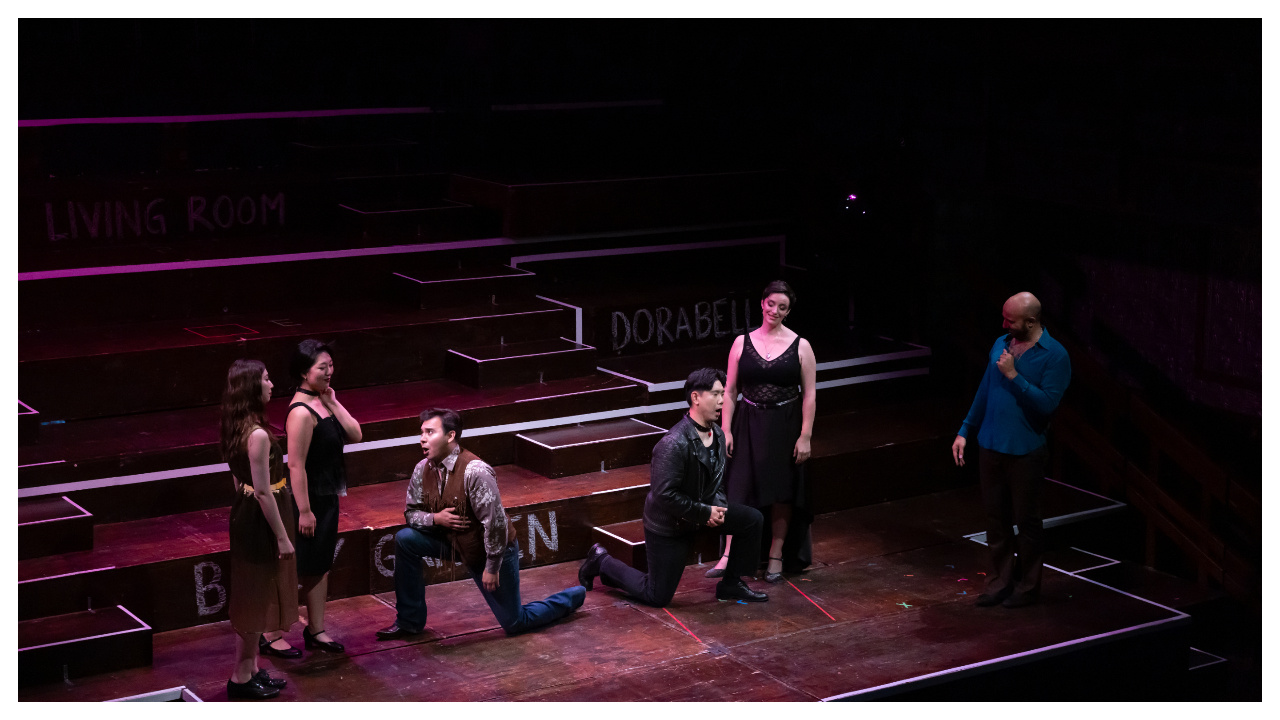
On July 17, 2026, Teatro Grattacielo opened their run of Mozart and Da Ponte’s beloved opera buffa, ‘Cosi fan tutte.’
Taking the drama to the present day, this concept staging presented the work with some modifications to the story and book. The men are presented as players on a sports team, and the later aspect of wooing the other’s lover in disguise was altered to Despina suggesting the couples try a partner-swap, to name just a few choices. Many of the decisions made in this vein landed with the audience, and they seemed to enjoy the comedy as much as the fine musicality.
This modernist framing of the work, in what is the directorial debut of Cate Pisaroni, opens the work up to examine its themes while retaining most of its focus. Taking on the mantle of Cupid, Pisaroni appeared usually between scenes to offer exposition or a recap tinged with a sassy perspective on the unfolding events, resulting in a flawed but funny narrator for the most part. This choice also seems to balance the male perspective of the libretto with a more feminine view on the characters and plot.
“The opera asks uncomfortable questions about desire, fidelity, identity, projection, and the roles we perform for one another,” says Pisaroni in the program notes. “Rather than approaching the work as a moral comedy, I wanted to explore it as an emotionally intelligent study of the human connection.”
While I felt the tiered, bleacher-style of the stage limited the mobility of the artists, they nonetheless utilized the space well. A cross-section was made where the higher and lower levels were for the garden and living room, and the left and right sides were spaces for Fiordiligi and Dorabella, creating boundaries to set a base while also overlapping when needed.

Heading up the orchestra was Abdiel Vasquez, whose expressive conducting brought tremendous vivacity from Mozart’s already-vibrant score, while displaying great attentiveness to the young singers. His flexibility also came into play as he accompanied the recitatives on the keyboard.
Playing Guglielmo, Young Kwang Yoo employed a robust baritone which seemed well suited his character’s initial certainty in himself and Fiordiligi, making for a swaggering rendition of ‘non siate ritrosi,’ and took on suitably-pained colors when that certainty unraveled later into the second act. His aria ‘Donne mie, la fate a tanti’ was both rich and scathing as he sought answers from the fairer sex, but still held the comedic aspect created by his earlier actions with Dorabella.
In the role of Fiordiligi, Lina Chung’s flexible soprano related ample amount of her character’s shifting emotions, running from jubilance, to bewilderment, to outrage. These qualities made for a fiery rendition of ‘Come scoglio’ where she reaffirmed faith in her lover while occasionally glaring daggers back at the men upstage. This defiance set things up nicely when she eventually succumbs to Ferrando’s advances, making for a highly charged atmosphere for their duet ‘fra gli amplessi.’
As Ferrando, tenor Ricardo Diaz displayed a sweet timbre that was often pleasing to hear through his time onstage. This affectionate quality made for an appealing rendition of his aria “Un’aura amorosa” with Diaz’s lyricism humorously undercut as Guglielmo and Alfonso casually ate pizza from the stage below. While there were moments where I thought he could have used a little more bite, such as when he learned of Dorabella falling for Guglielmo’s seduction, his softer texture translated very well to Ferrando’s later triumph when he turned the tables on his friend, resulting in some humorous gloating between the two.
Opposite him as Dorabella, Mairin Srygley, had a consistent, resonant mezzo which kept her at the forefront of the texture through her character’s antics. After her protestations in the first act, her second act aria ‘e amore un ladroncello’ was a well-delivered 180 on her prior attitude as Srygley capped off bubbly, lilting phrases with a relishing sostenuto to drive home Dorabella’s newfound feelings.
Playing Don Alfonso, Nicola Ziccardi proved more than able to balance the comedic aspects of the libretto with the musicality of the score, resulting in an entertaining take on the jaded yet expressive older friend. This was felt early on in the act 1 quintet as he broke the news to the women and set his wager into motion, where his farcical, aggrieved timbre suited the number excellently. Dramatically and vocally, Ziccardi played well with both male and female groups, and his interactions with Yang’s Despina made for a fine, comedic pairing as they schemed and occasionally sparred between themselves.

In the role of Despina, soprano Giovanna Yang’s performance was among the highlights of the evening. Having the chance to hear her some years ago, I thought this role was a humorous breakthrough for Yang as her cheery, soprano timbre nicely contrasted her character’s cynical phrases, most notably for her aria ‘Una donna a quindici anni.’ While her voice shone at its best among the more lyrical measures, Yang still handled quicker sections, like the patter phrases of her fake doctor disguise, with comedic energy and charm.
For the various modern details and sense of experimentation, there was an equal amount of self-awareness and humor which tinged the production and opened it up for interpretation. Pisaroni’s Cupid, having acknowledged her influence on the events of the plot, questions her efforts and ultimately defers to humorous figures: none other than Da Ponte and Mozart, played by Ziccardi and Yang, respectively, as they set to inspecting and correcting the staging and orchestra. Overall, these romantic tweaks at the hand of an outside figure lent an additional layer of absurdity to the events of the libretto, and while I felt the choice suited a comedy like ‘Cosi fan tutte,’ it also felt reminiscent of ‘A Midsummer Night’s Dream,’ which is no bad thing.
To paraphrase some remarks given by Artistic and General Director Stefanos Koroneos during intermission, this production is meant for the performers as much as it is for the audience, and creates a place where the next generation of artists can further gain onstage experience. In this regard, I found the production very much a success, with the cast giving an enthusiastic, humorous approach that did not lack for aural beauty and sincerity when needed. This enthusiasm did not fail to connect with the audience, and it was clear from the applause and laughter that they enjoyed what this production offered in both musical and creative direction.
Teatro Grattacielo’s production is one that is firmly rooted in the understanding of the opera held by its creative team, yet makes a bold effort in presenting a modern, gender-balanced take which comes from a place of humor and humanity as it pointed out the flaws in both sides while retaining a lighthearted touch. Lovers of accessible and entertaining opera can look forward to November, when Teatro Grattacielo will return for a program celebrating the 250th anniversary of America, featuring ‘Jefferson Lives!’ and Puccini’s ‘Suor Angelica.’