
The natural world has been a source of inspiration since time immemorial, leading to countless works of art as people explore and find ways to express the beauty of the world around them. This continues even today, where the advances of scientific equipment allow for new and interesting ways to observe nature.
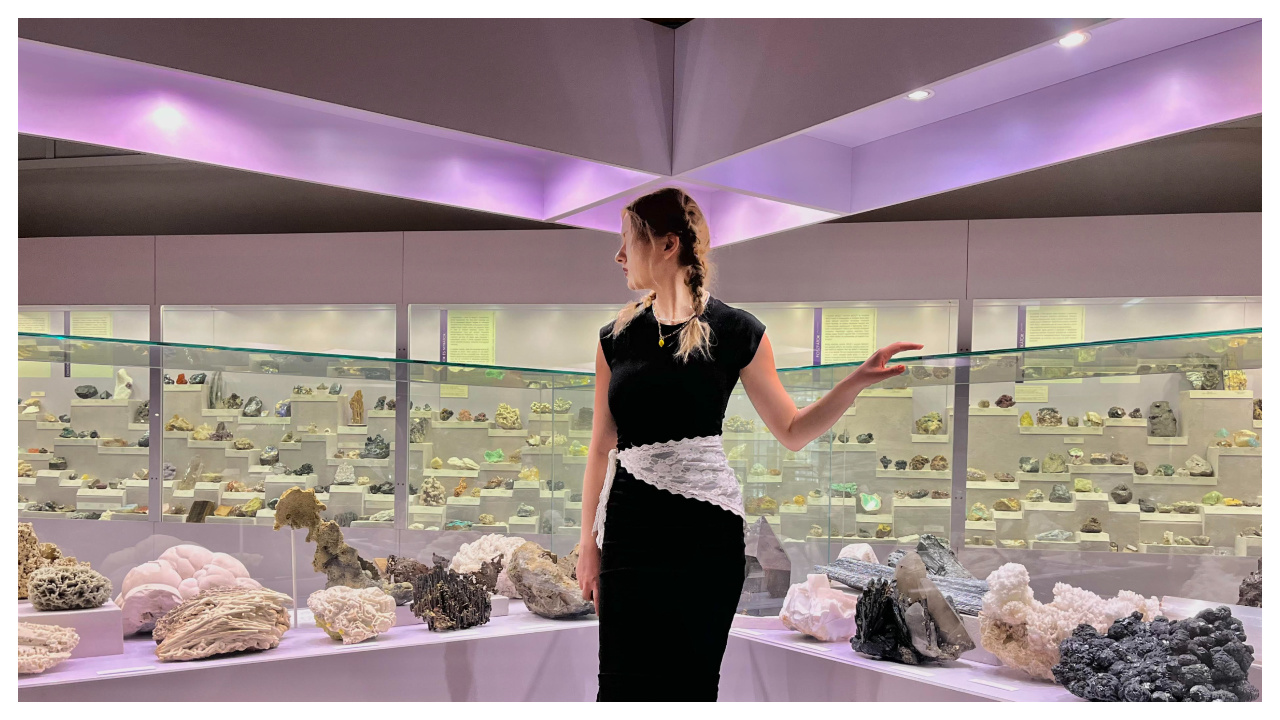
One such artist is Armenian composer and filmmaker, Manne Von M. Based in her native Yerevan, Von M’s works have been performed in venues through Europe and North America, and have earned her awards including the 2018 President’s Prize of Armenia. Most recently, Von M is currently hard at work on ‘The Elements,’ a collection of classical works for every element which comprises the Periodic Table.
StageFiend had the opportunity to speak with Von M, and learn more about this undertaking, as well as some of learn some of the things that drive her as an artist and a scientist.
SF: What was your inspiration for such an ambitious project? What has the composition experience been like so far?
MvM: “As a child, I had a strong desire to become a biologist or chemist. I remember my teenage years with the periodic table in my hands and conducting experiments in the backyard. Years passed, and I chose art—film and music.
Throughout my creative journey, I’ve always been building on science: space, ecological issues, quantum mechanics, radiobiology, and more. In music, this idea emerged quite unexpectedly, but the foundation had already been laid in my mind long before that moment. One day I simply wondered: what would all 118 elements sound like?
This is the world’s first Musical Periodic Table, which includes all 118 elements as a mosaic, where each element is an individual, self-contained musical composition․ I started working on the composition at the beginning of this year. I have to admit—it is not easy. It requires deep knowledge of chemistry and natural sciences, combined with musical expression. So I went straight to a university laboratory and asked: ‘Hello, could you tell me whether you hear these chemical reactions in my mercury?’
To my great joy, they welcomed my project and have been supporting it with a very academic and scientific approach, helping ensure everything stays in balance—science plus imagination equals ‘The Elements.’”
SF: If you had to pick one, which element has been your favorite to compose at this point in the process?
MvM: “Since I started working on this project, I’ve come to understand that each element is unique, just like people with their own personalities. I love each of them, but from a professional perspective, radium is the element that interests me the most.

Radium is extremely dangerous, and there is a dark human history connected to it, but for me, radioactive elements are endlessly fascinating. Radium represents mystery and, at the same time, light. As a musician, I heard the sound of radium as a fantasy for glass harmonica. It is an old instrument that is not used very often. It was invented by Benjamin Franklin. I would recommend that those who are not familiar with this instrument definitely discover its angelic sound, which also has a deeply calming effect.
In future projects involving this and other elements, I believe it will be a good opportunity to raise awareness about radiobiological and radiological environmental issues. Because I don’t only admire nature—I also believe that my inspiration should be meaningful and contribute something useful.”
SF: How would you describe working in a laboratory? What’s an average day like in that environment?
MvM: “In the laboratory, I am directly involved in scientific experiments. I conduct experiments myself and closely follow the ongoing processes, paying attention not only to the chemical reactions themselves, but also to the acoustic phenomena within the laboratory environment.
These can include various physical sounds—from the operation of instruments to the natural noises that occur during reactions, such as gas release or the effects of material interactions.
We know that in nature, even the same phenomenon never repeats itself in exactly the same way. The same can be said about chemical processes—they have their own dynamics and uniqueness with each occurrence.
It is not enough to only read about them in books; it is important to experience them firsthand. In working with each element, I try to explore the acoustic impressions created by these processes and translate them into musical ideas and notation.
In this approach, very different and sometimes unusual ideas come together, which, for me, become meaningful creative material.”

SF: As a musician and composer, what are some of the things you feel can be learned from the natural sciences?
MvM: “I think it is that nature does not have a self-destructive quality. If humans do not interfere, nature never destroys itself. The causes should always be sought within humanity.”
SF: Your works cover a wide range of subjects and themes, like your recent ‘Aria Sacra’ which sets text from the Bible. Do you find yourself using a consistent musical language across compositions?
MvM: “’Aria Sacra’ is one of my more recent works, written specifically for the brilliant mezzo-soprano Madison McIntosh, and I am, as always, deeply impressed by her performance.
I have several works based on sacred texts, such as ‘Mary’s Magnificat,’ ‘Ave Verum Corpus,’ ‘Angele Dei,’ and others. For me, sacred music is a space where you are in a constant process of refinement, and there is no final point of completion.
As for my creative language, it has recently shifted slightly toward a more contemporary expression. Today, for many composers, each new work can belong to a different genre or direction. This freedom is valuable because there are no longer strict boundaries—you can write a prayer on a sacred text using very traditional elements, and then your next work can be entirely avant-garde.
Ultimately, history will decide what label or definition will be given to the composers of this era.”
SF: After ‘The Elements,’ what do you see yourself doing next? Do you have any future projects in the works at this time?
MvM: “At the moment, I am working with the young and talented Armenian pianist Sophie Suvaryan, and together we are preparing to record the element Meitnerium.
This process is very interesting because the pianist brings her own interpretation, and the performer’s contribution is extremely important. It is here that the composition truly comes to life—Meitnerium, a synthetic and highly unique radioactive element.
Once the recordings are completed, I believe I will either develop a film project related to the elements, or continue with new science-centered musical ideas.”