
On January 29, 2026, New York City Ballet raised the curtain on their ‘New Combinations’ program. Featuring familiar works and one world premiere, this evening saw much to enjoy from the artists and orchestra.
Starting things off that night, was Balanchine’s ‘Walpurgisnacht Ballet.’ Drawing from Charles Gounod’s ‘Faust,’ the work was a soaring display of unity from the corps de ballet, whose dense presence on stage often resulted in fascinating arrangements of flowing lines or more complicated figures. The soloists that night were Miriam Miller, filling in for Sara Mearns who was out due to illness, Tyler Angle, and Olivia MacKinnon. Their pas de deux earlier in the work saw the two in fine sync as they demonstrated charming, easy lifts and supporting her through an en pointe stroll traveling against the line of the corps.
There was a fascinating contrast to be found in the sheer weight which comprises much of the work’s score, and the lightness of the staging, costumes, and choreography which featured bright pinks and purples. While the ballet itself removes much of the context of its source work, there was still a gripping sense of the ethereal being set loose from the earthly as the women flowed about the stage or engaged in embroidery through deft series of arabesques and attitudes.
Second on the bill was the pas de deux from August Bournonville’s ‘Flower Festival in Genzano.’ Featuring Isabella LaFreniere and Ryan Tomash, this selection held great romantic artistry for one to savor. A quick opening over a lyrical theme saw the lovers greet before Tomash affectionately watched LaFreniere engage in a series of spritely hops downstage. There were charming instances of chase and play which made their moments together all the more enjoyable as they demonstrated splendid partnering through deep cambrés, supported en pointe strolls, and more.

Through this work, there was a levity which almost disguised the challenges of the choreography, engaging in exchanges of phrases with a fun, almost-competitive flair, leaping tours about the stage, and other such measures delivered with emotions ranging from bashful to bravura.
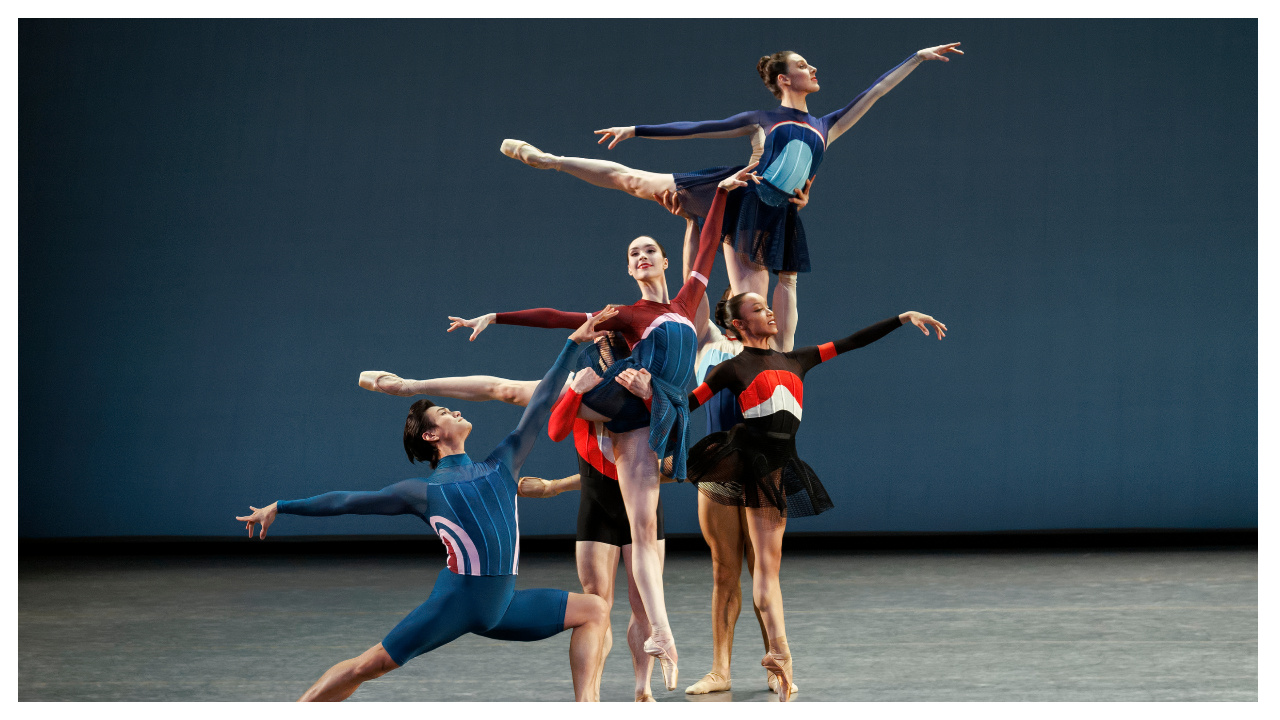
Third on the program was the world premiere of Justin Peck’s ‘The Wind-Up’. This new work is the 26th choreographed by Peck for the company, and is NYC Ballet’s 499th new ballet to-date. Set to the ‘Allegro con brio’ of Beethoven’s famous ‘Symphony No. 3 in E-flat Major, Op.55’ the cast featured well-rounded pairs of dancers such as Mira Nadon and Chun Wai Chan, Tiler Peck and Roman Mejia, and Mia Williams and Daniel Ulbricht.
As the lights flushed immediately to the downbeat of the orchestra, the audience was introduced to Ulbricht in a series of dynamic turns and floorwork which set a nice bar for the athleticism that would follow through the work. The other dancers quickly joined the stage, leading to a nice sequence where Ulbricht tumbled over the lying Williams while framed by the motions of the other dancers, as well as a quickly-executed tableaux of high lifts from the couples at varying heights to create a staircase-like effect before their arrangement splits back apart. This passage would become a tidy and energetic point of recapitulation as it returned at least twice more over the work.
Principals Tiler Peck and Roman Mejia were a splendid pairing, with the husband-wife duo displaying tremendous artistic technique and sensibility. Articulate in motion and in gesture, Peck’s fluidity could be seen through graceful passing steps between certain moves, and even in the midst of faster passages exhibited a consummate sense of elegance and control. Mejia also delighted through solo moments, featuring sharp port de bras and powerful pirouette combos chained into deft pivots, l’en air turns, and more.
Chun Wai Chan and Mira Nadon were also a source of much beauty and virtuosity. After an instance of dexterity where they seemed to repeat the prior couple’s measures at a faster pace, we’re later treated to some breathtakingly gentle moments such as a series of catches where Nadon’s lower body curved off to the sides with a slow, pendulous grace.
While Ulbricht’s acrobatic qualities were utilized to excellent effect, he also displayed some lovely partnering with Williams, such as how she was softly lowered back to stage during airborne moments, or the way she turned out from her supported cambré with lyrical flair. Williams also showed her strength and control in moments like the combination of floorwork featuring half-bridges and fast poses as the women hold down the stage with aplomb.
Overall, this was a highly interesting work that melded a charged, contemporary choreography with one of the most dynamic and enduring pieces of classical music, resulting in something that was as engaging in its physicality as it was captivating in its artistry.
Bringing things to a fascinating close was Jerome Robbins’ ‘Opus 19/ The Dreamer.’ Set to Prokofiev’s ‘Violin Concerto No. 1 in D Major,’ this psychologically-inspired work explores a man’s vivid inner world and the relationship with the object of his desire, danced by Anthony Huxley and Alexa Maxwell, with the violin solo provided by Kurt Nikkanen. The expertise of Nikkanen was yet another treat of the evening as he outlined everything from rapid, jubilant trills to a flatlining pulse in conveying the romantic fervor of the focal character.
As Huxley opened with sweeping, contemplative phrases, the ensemble behind him flowed between mirroring his movements or establishing various lines and figures. His nearly-frantic mental state could be seen from touches like the quick turns and reaches as if desperately searching for something, or a later instance of a deep slump as if needing a moment of respite.
Maxwell evoked a superb sense of the ethereal as the nameless ideal of the titular dreamer. Entering with fluid handwork, she quickly displayed things like plush turns under her supported leg and high lifts which easily established a less-earthbound nature. Between aspects like her frequent entrances and exits, or the way she skimmed en pointe to stay opposite of his turning gaze, there was a breathtaking sense of pursuit, meeting, and parting which defined much of this piece. These aspects were only amplified when these two artists came together for some truly beautiful partnering. The resulting was a finale that, while bearing necessary amounts of anguish or desperation, was still rich with affection and the seeming elevation of love.
Thursday’s program had nearly all one could ask for, with grand ensemble works, beautiful pas de deux which explored the brighter and darker sides of romance, and a fascinating world premiere nestled between it all. As New York City Ballet continues their Winter season and readies for their upcoming ‘Sleeping Beauty,’ they will no doubt continue to excite audiences with such passionate artistry.