
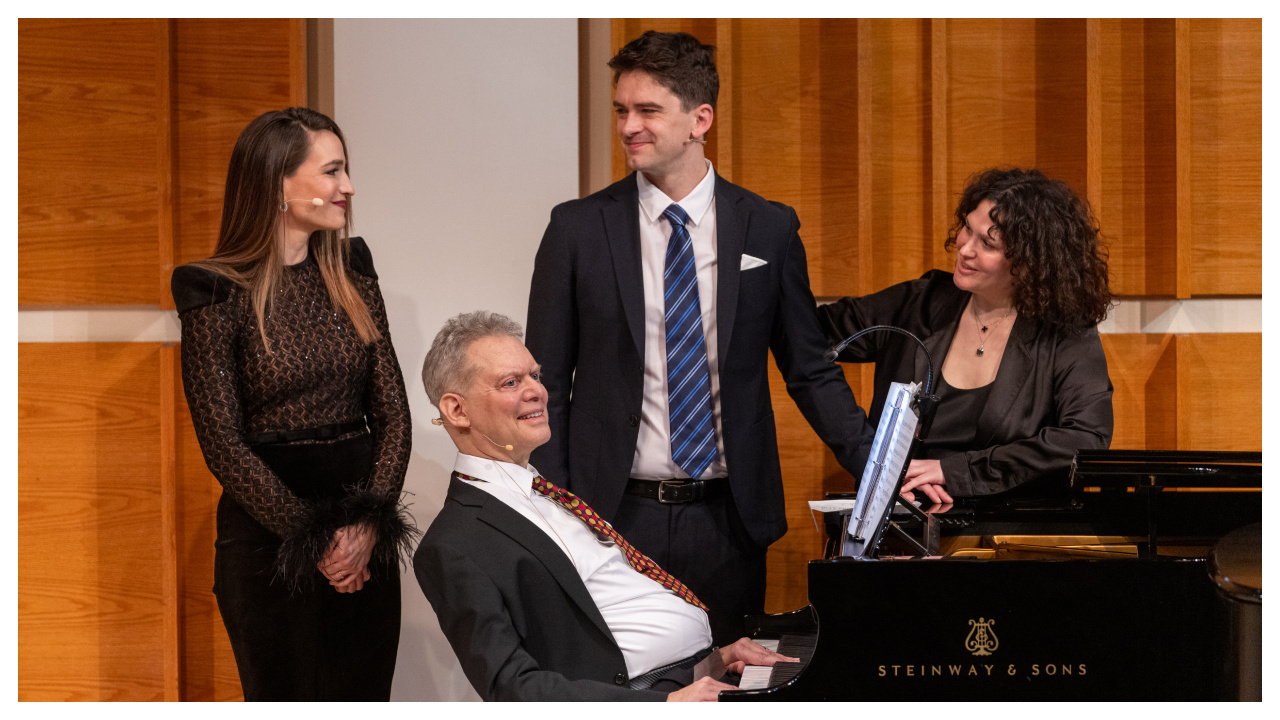
On February 12, 2026, New York Festival of Song presented ‘Fugitives.’ This program, comprised mostly of German lieder and art songs, sought to shed a light on Jewish composers who were forced to flee Germany due to Nazi persecution. Presented by Artistic Director and pianist Steven Blier, the concert featured mezzo-soprano Kate Lindsey and baritone Gregory Feldmann, accompanied by either Blier or pianist Bénédicte Jourdois.
Often displaying a rich baritone, Gregory Feldmann navigated the varying styles with flexibility and much artistry. Having joined the recital a week beforehand to fill in for another artist, Feldmann nonetheless was in fine form vocally and more than comfortable with the German texts. This was demonstrated well in his initial number, Zemlinsky’s ‘Altdeutsches Minnelied,’ where he balanced a forte delivery with a charged, affectionate warmth.
Mezzo-soprano Kate Lindsey was also a source of great captivation across her selections. One of her earlier numbers, Schoenberg’s ‘Erwartung,’ carried with a suitable, nearly-desperate sense of yearning, all the more potent through Lindsey’s magnetic and expressive instrument. These qualities were taken to tremendous heights for her later selection, Weill’s ‘Wie Lange Noch?’ I often see German art songs as having a great composure, so this musical nervous breakdown came across as arresting as it was powerful.
The program saw a variety of moods and subjects, such as the sheer romance of ‘Unendlich liebe’ or the more politically-framed ‘When the Old Car Works Again,’ creating a broad tapestry of sentiments. While the premise of the recital carried a certain gravity, there were still moments of lightheartedness, such as Kurt Weill’s ‘Buddy on the Night Shift,’ where Lindsey and Feldmann gave two humorously-contrasting interpretations of the same text.
There were many interesting things about the recital, from its well-curated lens on persecuted artists, or the particular talents of the soloists that night, I felt there was a lot to engage with. That being said, I could not help but feel it suffered from a presentational standpoint due to the frequent, and rather extended, instances of context provided by Blier. Done sparingly, it can add valuable insight to the selection about to be performed, and it did at times thanks to Blier’s knowledge and experience, but it often brought the energy to a near-standstill, and over the course of a program featuring about 20 songs, this happened quite a lot. Given the program notes and lyrics, provided with enough lighting in the audience to make the text more than readable, these interludes unfortunately felt redundant.
Despite these slowdowns, I can honestly say that Thursday’s concert was highly informative and well-received, with the artists drawing much applause from the audience for their efforts. New York Festival of Song is set to continue their season in March with an original program titled ‘To the Sea.’ Featuring Caramoor’s 2026 Schwab Vocal Rising Stars, this will no doubt make for an exciting showcase for some of classical music’s most prominent young artists.