
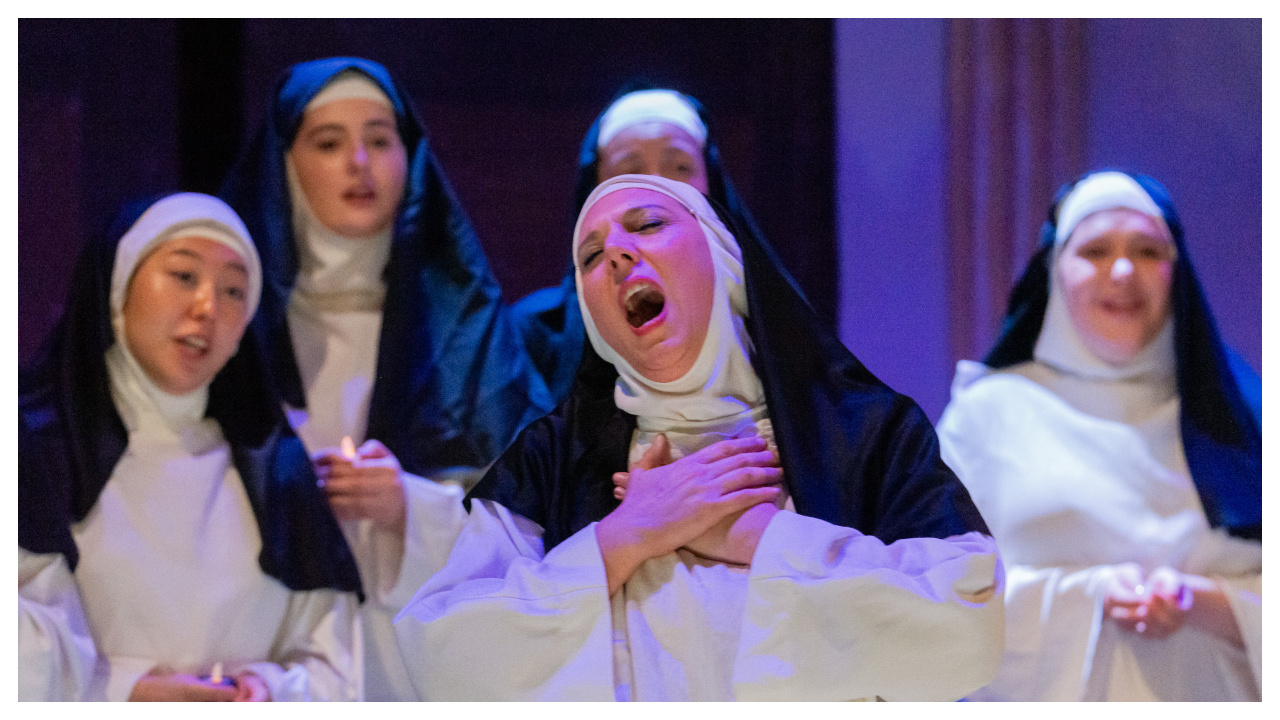
On March 1, 2026, Regina Opera Company continued this season’s run of Puccini’s ‘Suor Angelica.’
Puccini’s score was expertly highlighted by the orchestra, led by Scott Jackson Wiley, evoking the churchly atmosphere of its scenes through evocative chimes, harps, and various figures from the higher winds. The all-female cast saw a range of voices, from Melaina Mills and Sea Jeong Jang as the Alms Sisters cheerily doling out provisions from the outside; or mezzos Janelle Kirton and Rachel Spund as the Monitress and Abbess, both having a distinct sound despite their similar range to emphasize their approaches to obedience.
In the title role, soprano Sara Beth Pearson brought great dramatic and vocal fervor to flesh out her interpretation. While a disconsolate undertone carried through much of her calmer moments, these emotions brought forth impressive, and at times highly-arresting, colors from Pearson when they rose to the surface. This was shown early on with her charged phrase “Oh, sister, death is beautiful life!”
Her time with the princess was similarly gripping as the composure Pearson brought was unraveled by the various news from the outside world. From her brighter phrases rejoicing in her sister’s upcoming marriage, to the anguished bite as she accuses her aunt “you are pitiless!” there was a wide range of emotions which Pearson did well to illuminate. All this made for an excellent setup for her aria ‘Senza mamma’ where she opened with a balance of heartache and a sense of distant withdrawal. This built with a grievous power for phrases like “you died not knowing how loved you were” or more sustained lines across the upper reaches of her voice. All these qualities made for a near-showstopper as Pearson brought things to a crushed finale.
Her closing scene was beautifully handled as Pearson ran the gauntlet of madness; brewing the poison with a pained, ironic callback to her earlier praise from the sisters; her utter panic upon realizing her mortal sin; and the awed passion of her ultimate atonement. Though the work is only an hour or so in length, Angelica’s constant presence and the intensity of her music were challenges that Pearson rose beyond that afternoon.

As The Princess, Erica Koehring made a powerful showing as Angelica’s imperious aunt. The icy demeanor which tinged her entrance, ripe with stoic, declamatory lines, was captivating to watch slowly melt as she revealed her own pains. This made her rendition of ‘Nel silenzio’ as nuanced as it was sonorous as Koehring’s contralto related powerful phrases like “offer to the Virgin my justice!” While her time onstage is brief, Koehring truly made the most of her time in this antagonistic but sympathetic role.
As Sister Genovieffa, Veronica Mak often brightened her moments onstage thanks to her clear soprano. Her opening lines carried with a suitably-bubbly quality as she told of the sparkling fountain. Mak also provided instances of great sentiment as well, such as her measures of longing and reflection on her old life as a shepherdess, leading the ensemble of nuns to a low, prayerful close; or later when she gathers the rest of the sisters to wish the approaching carriage be for Angelica. Through the little moments of this supporting role, Mak added much to the unfolding scene, making the convent feel like a warmer place in a story that’s set against the rigidity of social structures.
The set itself was traditional and effective, depicting the outer courtyard with a view into the chapel. The building split the yard neatly into one open side with grave markers, and one “deathless” side sealed off by a gate; without over-analyzing, the impression I felt was one of only being able to go forward in life toward its conclusion, rather than try to return to a place that seems to be without death. Given Angelica’s later emotional turmoil and suicide, this staging reflected her psyche quite well and with rather simple choices.
The result was a powerful and faithful performance of this compelling Puccini work. While normally presented with the rest of his ‘Il Trittico’ the work also gets billed with smaller pieces to make for a fuller program. The second half of the show featured two instrumental works: Handel’s ‘Concerto for Harp in B-Flat Major Op. 4 No. 6,’ and Haydn’s ‘Concerto for Trumpet in E-Flat Major, Hob. Vlle/1,’ but due to time constraints I was not able to stay past the intermission. Regardless, Regina Opera Company managed a splendid foray into the space where the worldly and heavenly meet, rich with suffering, eventual atonement, and some very fine music throughout. Lovers of opera can always count on Regina to present quality works in highly accessible performances.