
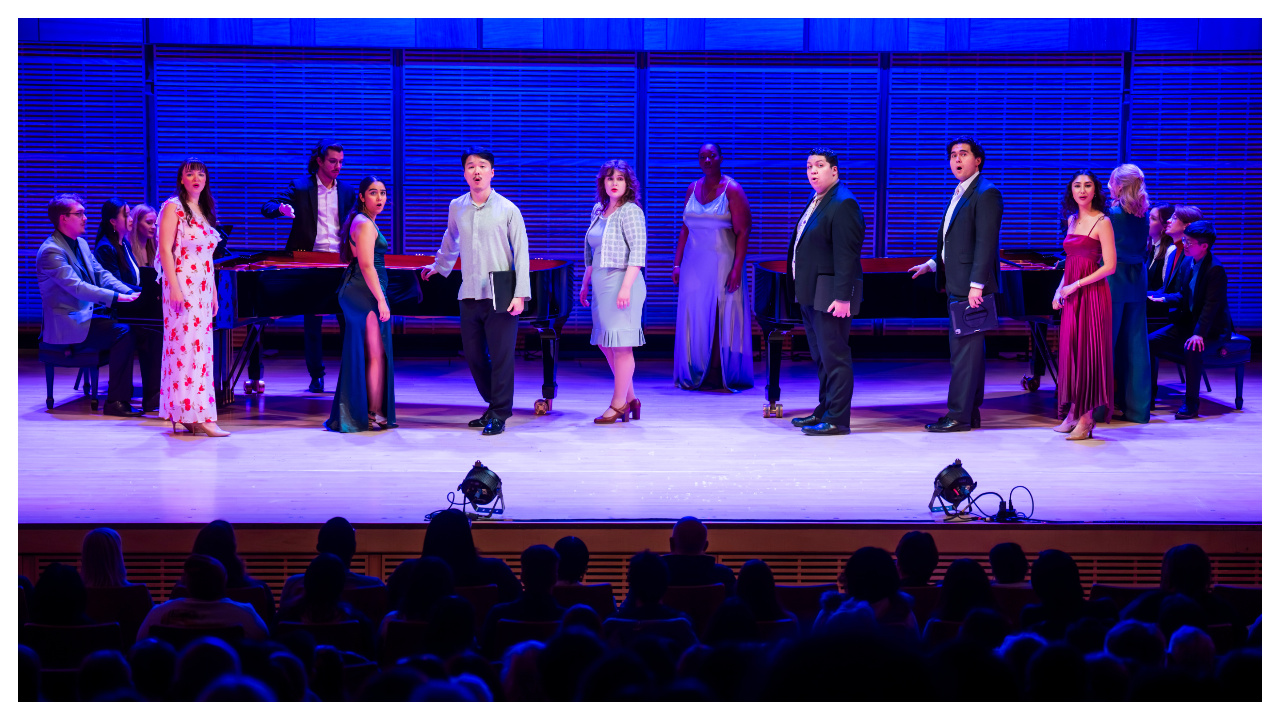
On January 12, 2026, Carnegie Hall launched their annual SongStudio. This series of masterclasses pairs exceptional young singers and accompanists with leading operatic artists to workshop different arias and art songs over five days, culminating in a showcase recital at Zankel Hall.
Hosted by countertenor and Opera Philadelphia General Director Anthony Roth Costanzo, this year’s roster of artists includes sopranos Nisha Patel Caiozzi and Madison Marie Fitzpatrick; mezzos Madelin Morales, Naomi Steele, and Lauren Torey; tenors Philippe Durant and Edward Ferran; baritone June Young “Will” Kim; and pianists, Felix Otto, Filipe Gaio, Marite Manni, Daniel Prinz, Anna Gebhardt, Wan-Yen Li, Anna Giorgi, and Muse Ye.
The first day saw a masterclass with renowned soprano Lisette Oropesa. Due to being at a different show at the venue that evening, I was not in attendance for this event; this article will reflect the remaining classes and recital of the festival.
Day 2
The second day saw the students work with pianist Bryan Wagorn. As a soloist and accompanist, Wagorn has performed with leading companies such as The Metropolitan Opera, the New York Philharmonic, and singers such as Nadine Sierra, Angel Blue, Joyce DiDonato, and more.
“It’s kind of like if you went to your annual physical, but there was a room full of people,” succinctly quipped Wagorn on the structure of the classes. Having myself attended a number of SongStudio classes from prior years, there is indeed a great aspect of vulnerability involved as artists and teachers publicly comb over and fine-tune all the small artistic choices which shape a performance.
First that night was Caiozzi and Gebhart, working on Samuel Barber’s ‘The Desire for Hermitage.’ After their initial take on the piece, featuring some bright, pious textures from the two, Wagorn briefly touched on some its performance context, and encouraging them to integrate sensory aspects like tying the lighter piano material to the tolling monastery bells, or the faith-based anguish of the text which deepens the contrast between its surrounding beauty and its narrator’s inner turmoil.
Next was Kim and Li, with ‘Bitte’ from Swiss composer Heinz Holliger. After introducing some of the background behind this piece, Kim and Li quickly dove into all the weight and darker colors within the composition. Touching upon the angst of the piece, Wagorn had the duo explore the instability of the narrator’s emotion, and the sense of exchange between voice and piano to help accentuate these shifts.
After this was Morales and Gaio with Messiaen’s ‘Pour quoi?’ Framing her rendition around the composer’s faith, there was great introspection as she mused on the nature of things. Here, Wagorn had the pair connect more with the context of the piece, given the composer’s youth and recent loss of his mother, and the sense of dissatisfaction that prompts this string of questioning.
Last for this evening was Durant and Giorgi, with Schubert’s ‘Ganymede.’ Wagorn encouraged the duo to explore the sense of journey within the number, contextualizing it around Schubert’s sense of arc in a time where music often circled back on itself in ensuing sections. Taking to the piano, Wagorn briefly demonstrated the progression felt by certain aural effects, like the walking bass line as it builds to more heavenly heights in strong connection to Ganymede’s own elevation to Olympus.
This class held much insight thanks to Wagorn’s experience as a pianist, and the artists and audience alike could hear the changes as the performers refined their approach to their chosen works.
Day 3
After a day’s break, SongStudio resumed on January 15, with a masterclass by Anthony Roth Costanzo. First up that evening was Torey and Prinz with Britten’s ‘Johnny.’ By exploring some of the emotions behind each of the sections, Costanzo was able to guide Torey into not only connecting them more cleanly, but drawing more interesting colors from her jubilant mezzo through changing the placement of her sound when needed.
Following this, Caiozzi and Gebhardt returned to workshop ‘Hyacinth’ by Margaret Bonds. Here, Costanzo touched upon the idea of “legato energy,” and strategies for keeping a sense of continuity through calmer sections through working on breath and the irregular rhythm held by some of the phrases.

Third that night was Ferran and Ye, with Ildebrando Pizetti’s ‘I Pastori.’ After a charming run of the piece, Costanzo did much to help Ferran connect with the passionate qualities of the song, as well as guide him on phrase-work and production of sound more in-line with the style of singing to be found when the piece was first composed.
Last of the evening was Fitzpatrick and Otto, with Saint-Saens’ ‘Danse macabre’ By changing the placement of her sound, Fitpatrick was able to bring greater clarity to her French diction even through the rapid tempo of the phrases, resulting in a rendition that played well to the piece’s fun, deliberately-spooky energy.
Day 4
The final day of masterclasses saw the student pairs coached by famed tenor Lawrence Brownlee, who is currently performing in the Metropolitan Opera’s run of ‘I Puritani.’
The first pair was Steele and Mani, with Margaret Bonds and Langston Hughes’ ‘Dream Variations.’ Brownlee coached mostly on diction to bring the very most out of the poetry of Hughes’ text, leading Steele’s naturally lovely soprano to a more consistent and clear sound overall.
The second pair, Ferran and Ye, worked on the piece ‘Aprile’ by Francesco Paolo Tosti. This sensory-based work saw Brownlee and Ferran explore not only the effect this imagery has upon the narrator, but the placement and shaping of sounds to add a more vivacious quality to his approach.
Next up was Kim and Li, with Schubert’s ‘Nachtviolen.’ After a beautifully-delicate rendition, Brownlee coached Kim on strategies for creating the moment to lend a deeper emotional impact to his phrases, asking Kim about his thoughts on the narrator’s personal contexts to shape a more individual take on this classic lied.
Last up for the night was Durrant and Giorgi, who performed the first half of Schubert’s classic ‘Dichterliebe.’ While time constraints prevented me from staying to watch Brownlee work on this with Durrant, I was nonetheless taken with the latter’s rendition, and found it well-suited to his eloquent tenor.

The Recital
Sunday saw the artists of SongStudio take to Zankel Hall for the concert which brings their week of classes and practice to a well-deserved close. Having attended former years of the workshop, I came in with the notion that the recital would be as usual, namely a straightforward program of roughly-twenty different art songs which would display the talents and progress made by the student pairs. Due to the artistic direction of Costanzo and a number of surprises, this year’s showcase was all that and so much more.
This time around, Costanzo has employed a team featuring artistic advisor Javier Arrebola, stage director Doug Fitch, arranger Dan Schlosberg, and lightning designer Nicholas Houfek, to create a beautifully-touching showcase program titled ‘Songs from the Edge of Reality.’ By weaving a thread of narrative through a few small touches, the program became something which I feel took SongStudio to a new level entirely.
Through the light use of certain props, the students were able to interact with their surroundings on stage a little more, and figuratively pass the baton on to the following artists in ways which were both charming and thematically consistent. Early examples of this included Caiozzi ending her initial song under an umbrella, before handing it off to Durrant as she spied clearer skies; as well as the glittering sheet which is shed by Steele and later taken up to comfort Torey at the end of her own number not long after.
The pianists were also set loose from their position at the keys and took an even greater part in the fun, such as the instrumental numbers like Mussorgsky’s ‘Ballet of the Unhatched Chicks’ where pianists Prinz and Ye exchanged and outlined many light, humorous phrases, or the second half’s ‘Knockout: A Rag’ played by Gaio and Li with a fun sense of competition. The pianists also led one of the evening’s comedic highlights with Satie’s ‘Morceau 3,’ which saw them slowly frolic the stage in dark clothes and bowler hats like eight Charlie Chaplins stuck in adagio, all the while rotating positions at the keys.
This approach led to many of the songs feeling not only connected with each other, but also more consistent within each artists’ own styles and personalities. After the brief instrumental opening of ‘1,’ from Dutilleux’s ‘Figures de resonances’ where the dissonances and creeping melodies evoked a sense of unformed energy, we are instantly presented with Nisha Patel Caiozzi’s rendition of ‘Ek shabd,’ from Reena Esmail’s ‘Chuti Hui Jagah.’ This entry carried with prayer-like affection from Caiozzi as she navigated the rhythm of the Hindi phrases, all while displaying a relaxed yet clear soprano which crested beautifully when needed. Her later number ‘The Lorelei’ by The Gershwins, was a humorous yet charming contrast as she related the story of the seductive and dangerous figure. Here, Caiozzi had much fun as she employed a more unabashed approach, adding touches of nasally grit and raunchy weight to some of the flirtier phrases, and scatting through the instrumental sections. The result was an undoubtedly fun showing from Caiozzi.
Another example of fun contrasts came from Lauren Torey, whose initial song ‘Hotel’ from Poulenc’s ‘Banalities’ fittingly saw her with fake cigarette in hand as she mused on the sense of imprisonment within the brief French text, well conveying a languid sense of ache through her aggrieved-but-controlled mezzo-soprano. Her later number was Louis Guglielmi’s ‘La vie en rose,’ where Torey softly exulted in the idyllic imagery, beautifully relating Edith Piaf’s text as if it were for the first time, and even displaying some very fine whistling to lend a touch of whimsy to the instrumental section. Torey’s delivery was deeply charming, and I’d be a liar if I said I wasn’t mouthing along at times.
Continuing in this theme was Naomi Steele, whose entry with ‘The Cloths of Heaven,’ was deeply affectionate through its tender heartache thanks to the great richness of her mezzo-soprano as it lent manifold colors to the text of W.B. Yeats. Her beautiful, almost-wounded phrases, and the sacrificial love of the narrator mingled perfectly as Steele dropped her glittering sheet to stage as she departed, as if an angel losing her wings. Her later number, Satie’s ‘La diva de l’Empire,’ framed herself as the object of everyone’s eye with much humor to be found in her French phrases. This sense of excitement saw Steele briefly lean into a sassy spoken voice, as if needing to vent some of the steaminess she had worked herself into.
Tenor Philippe Durrant also nicely intimated a sense of contrasts. His first number, Poulenc’s ‘Hyde Park’ was full of imagery charged by Durrant’s regal tenor as he illuminated the sights and scenes of the narrator’s surroundings. His later selection, ‘Galathea’ from Schoenberg’s ‘Brett-Lieder,’ saw him relate utter infatuation with the titular woman, maintaining a breathtaking quality and the necessary support as his passion led him about the stage and even into a brief stage fall.
This was also the case for baritone June Young “Will” Kim, who delivered a truly fine rendition of Ralph Vaughan Williams’ ‘Whither Must I Wander?’ His take carried with richness and sensitivity through Kim’s baritone, lending much to the disconsolate phrases. His second selection, Monique Andree Serf’s ‘Gottingen,’ was a highly charming journey where the many images of beauty were all rooted within the titular locale, as opposed to the lack of one in his preceding number.
There were also selections which explored complimentary ideas, such as with Madison Marie Fitzpatrick. Her first selection was Passatieri’s ‘Ophelia’s Lament’ which sets to music some of the madness of the tragic Shakespearian woman, and was hauntingly related by Fitzpatrick’s resonant and expressive soprano as she navigated the darkening, elevated nature of the text. Her selection in the second half, Tom Cipullo’s ‘The Pocketbook’ from ‘How to Get Heat Without Fire,’ explored obsession through a far more material perspective, weighing the value of the things in her life against the eponymous accessory with great comedic flair.
One could also say the same of Edward Ferran, whose initial song, ‘Let me Enjoy the Earth,’ from Gerald Finzi’s ‘Till Earth Outwears,’ held much lyrical beauty as his charming tenor related a sense of solace in the narrator’s lack of belonging. His number in the second half, Bernstein’s ‘I Hate Music,’ was a source of much humor as Ferran initially walked among the pianists during their ensemble Satie number with much confusion, setting up his rendition well as he delivered dulcet phrases which spoke a more personal and understandable sense of beauty.
A flighty sense of fun was also found in the songs from Madelin Morales, first with Jake Heggie’s ‘The Leather-Winged Bat.’ Morales energetically started this first piece while flapping a small bat on a stick, as her beaming mezzo-soprano pattered over the chipper lines of different animals reacting to loss. Her sense of comedy let her build to the punchline well as the bluebird is seemingly rewarded for infidelity, before charging off with the same cheeriness as she entered. Her later number, ‘Rabbit at Top Speed’ from Bernstein’s ‘La Bonne Cuisine,’ saw her make great use of the tray of props wheeled before her as Morales’ bright voice and energy was finely and humorously contrasted by her aggressive preparation methods as she hammered, cut, boiled, and more to serve up plenty of laughs.
All of these selections felt like they served the purpose of the narrative being built, and effectively showed the individual talents of the artists. Where things got really interesting, were the ensemble numbers. The first half was ended with ‘Where or When’ from Rodgers and Hart’s ‘Babes in Arms.’ This Broadway classic was taken to gorgeous heights through stunning harmonies from the different vocal parts, with the uncertain sense of connection within the text feeling wonderfully appropriate for the theme of missed or brief encounters established by the transitory moments between the various numbers. Seeing and hearing the artists come together in this way was nothing short of gorgeous, and I was as surprised as I was delighted to experience this arrangement.
The second half was closed out by a similarly-stunning medley comprised of two unlikely selections. The first was Joe Raposo’s ‘Bein’ Green’ where Ferran’s warm, conversational tenor led the texture as he and the ensemble related the phrases of self-comparison with great beauty and introspection. In a humorous yet highly-artistic touch, their final harmony slid down the note as the ensemble modulated into, of all things, ‘Bohemian Rhapsody.’ Queen’s timeless classic was something to behold as Durrant outlined the initial “operatic” section with impeccable diction backed by the ensemble’s harmonies and traded phrases. There were moments of humor to be found in this number as well, such as the air guitar from Fitzpatrick as the ladies’ roulades built the charge for the ensuing “rock” section. Despite not being in the usual wheelhouse of classical singers, the youthful energy of the artists was well-suited to this arrangement, and made for a truly breathtaking finale.
As I said before, I came in thinking I knew more or less what to expect, yet I left not only mesmerized, but also feeling emotionally gut-punched by Anthony Roth Costanzo. The recital and program gorgeously chrysalised the journey of the artists and their own experience working with the teachers and with one another. Costanzo’s experience not only as an artist and administrator, but as a former student of the program, perfectly equipped him to create such a compelling showcase. As the students take what they learned as they continue in their careers, the future of the arts is indeed looking very bright.