
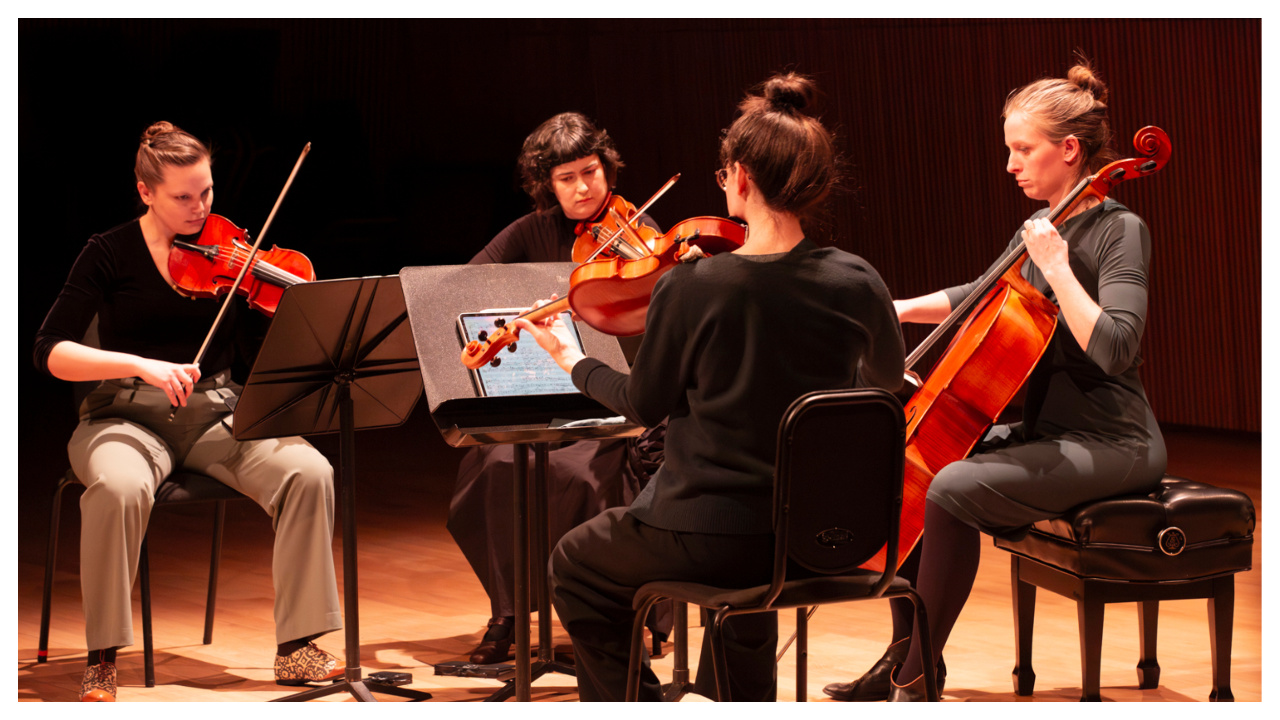
On March 21, 2026, the Ukrainian Contemporary Music Festival concluded with a gripping line-up of modern works. The last two nights focused on ‘Places’ and ‘Peoples’ respectively, with this night’s program titled ‘Practices’ as it drew from and explored themes of musical experimentation and spirituality. This bill of string quartet works was performed by female ensemble The Rhythm Method, comprised of Marina Kifferstein, Leah Asher, Carrie Frey, and Meghan Burke.
Opening the concert was ‘To Maria’ by Hanna Havrylets, which carried with great affection and a charming, nostalgic melody through its course to make for a touching introduction to the evening in store. Composed as a prayer to the Virgin Mary, the prayerful nature of this piece was expertly established by the warmth and clarity of the musical textures.
Second on the program was Ihor Zavhorodnii’s ‘Music That Leaves Itself.’ The program notes framed the piece around the concept of apoptosis, where cells are programmed to die, likening this journey to the one made by caterpillars as they dissolve to eventually become butterflies. Making its U.S. premiere that night, the work made a powerful impression as the texture often smoothly crested into a extended, siren-like passages of sound which easily filled the intimate space. With dissonant, uneasy fills interspersed throughout, there was a sense of urgency which pervaded this work.
Next up was ‘String Quartet No.1’ by Stefania Turkevych, recognized as one of Ukraine’s first female composers of classical music. The brief, often overlapping phrases evoked a reflective yet restless atmosphere, and their seemingly-deliberate lack of a clear thematic direction was highly reminiscent of the works of Schoenberg, whose Vienna lectures were said to be attended by Turkevych in the 1930s according to the program notes. Nonetheless, this work made for a solid close to the first half of the program.
After the intermission, the concert continued with composer-in-residence Alla Zahaykevych’s 2009 ‘String Quartet,’ originally composed for famed Ukrainian quartet Collegium. The heightened, dissonant lines did much in conjuring a sparse, unsettling mood, while the infrequent trills or bows of the cello lent a sense of uneasy, lurching movement through this space.
This feeling was explored in great depth with the following selection, Boris Loginov’s ‘sleep during insomnia.’ According to the composer, the work draws from the constant unease caused by the war, which would prevent or disturb moments of rest, blurring the lines of real and unreal. Building from the hushed opening, the lapping of the strings swelled to a powerful crest before it was washed away by the tolling of heavy bells. There were also more hopeful, lyrical section which provided a fine sense of contrast with the grave feelings that had been laid out earlier.
One point of consideration emerged between the selections and a conversation I had with one of the organizers after the concert, who rightfully mentioned a number of people, some of whom had recently been displaced by the war, found the musical references to the conflict disturbing. While no easy answer emerges in the question of how an artist balances stark reality with music’s ability to either amplify or soften more difficult aspects of life, it was nonetheless a sentiment that powerfully reminded me of how present the war still is for so many people, and how these experiences end up influencing one’s art.
Last on the bill was Valentyn Sylvestrov’s ‘Icon.’ This 2004 composition, first written for the Rosamunde Quartet, is styled after Christian Iconography and follows in the composer’s style of exploring themes of spirituality. While a brief number, the work succeeded in relating melodies which were uncomplicated yet rich in emotion, at times feeling elegiac, and creating an undoubtedly prayerful atmosphere to seemingly resolve all the prior strife and dissonances of the earlier selections.
Wrapping up the evening, and the festival as a whole, was UCMF’s ‘After Dark’ event. Taking to the Ukrainian Museum in the East Village, patrons gathered for light food and drinks, and to enjoy a number of jazz selections from musicians including Wayne Escoffrey on saxophone, Akili Bradley on trumpet, Bar Filipowicz on bass guitar, David Hawkins on drums, and joined by Ukrainian-Crimean jazz pianist Usein Bekirov. This afterparty made for a fine nightcap, with jazz covers of traditional and modern Ukrainian songs such as ‘Carol of the Bells’ and more.
Coming in direct response to Putin’s claim of a lack of a distinct Ukrainian culture, the UCMF has for several years now presented modern work by Ukrainian composers laden with all the joy and anguish of the recent conflict and their nation’s rich history. Given the ongoing reality for many Ukrainians worldwide, it feels remiss for me to call this festival a celebration, especially given the heavier nature of Saturday’s program in particular, yet creating and presenting art in times of adversity is truly a vital part in rejecting despair, and this sense is what I ultimately left with that evening.